GPS Bike Computer
Last updated 2026-08-18
July 2025: Where it started
I spent the summer of 2025 cycling around the Bay Area on a pair of bikes. It was a fun, low-stakes adventure that allowed me to explore the area. Racking up 60 to 70 miles a day, I wanted a simple odometer and perhaps a GPS device that could map out my route. All of the off-the-shelf bike computers are fancy little fitness tools that track power, speed, blah blah blah. I don't need more robots tracking my every move; that's what my smartwatch already does.
So, I figured I'd get some time with the ESP32 ecosystem, build my own—one that does exactly what I want, and precisely nothing more.
April 2026
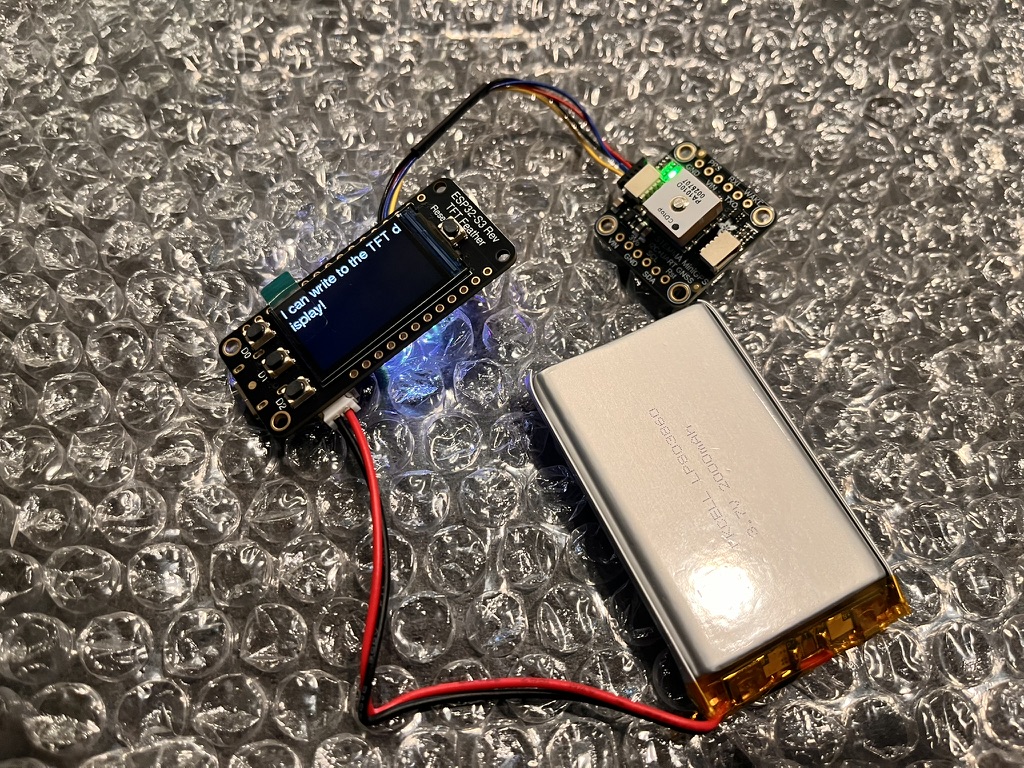
I recently learned that my original codebase was trashing my GPS speedometer results by repeatedly failing to interpret GPS data because I was handling tasks in a really dumb way. Scooting on over to FreeRTOS and having GPS parsing be its own little routine almost entirely eliminated all the issues I was having with the GPS module. The speedometer is spot-on, with a very reasonable 2-second lag.
As it stands, the computer now logs GPS coordinates every 20 seconds and then plots a little trace of the path taken against a blank black background. I can collect the coordinates as a GPX file over Wi-Fi and then do whatever I want with them. The odometer also works—at the very least, it agrees with my car.
Next steps are to design an enclosure, get deep sleep working on the ESP32-S3 Mini, and stick the thing to my bike.
For now, the computer lives in a plastic box on my desk. I get the privilege of looking at it every day and thinking about how I want to avoid solving its problems. Sometimes, I even pack it up in my suitcase so that I can procrastinate in another zip code.
In the meantime, I've gotten marginally better with the ESP32 ecosystem through a handful of other projects that are notable for being finished.
August 2026
I think I've just about wrapped up the firmware / software side of things. GPS data collection is reliable (at least, with a little filtering to trash obviously bad data—too far away, impossibly fast, et cetera).
I've taken it with me on a few rides at this point, letting it bounce around in my frame bag. So far, in the 190-odd miles of actual use its odometer has racked up, I've encountered no issues.
So that leaves the project in a weird state: more or less complete electronics, usable firmware, and a prototype enclosure. The prototype enclosure sucks and deserves a thorough redesign effort at some point in the near future. I'll write up something when I eventually get around to it.